Join a New Ball of Crochet Yarn Without Losing Your Place
Running out of yarn creates two tasks: connect the new supply using an appropriate method and preserve the pattern position. Keep the old label, compare the new ball and test the finish on spare fabric before relying on an unfamiliar join.
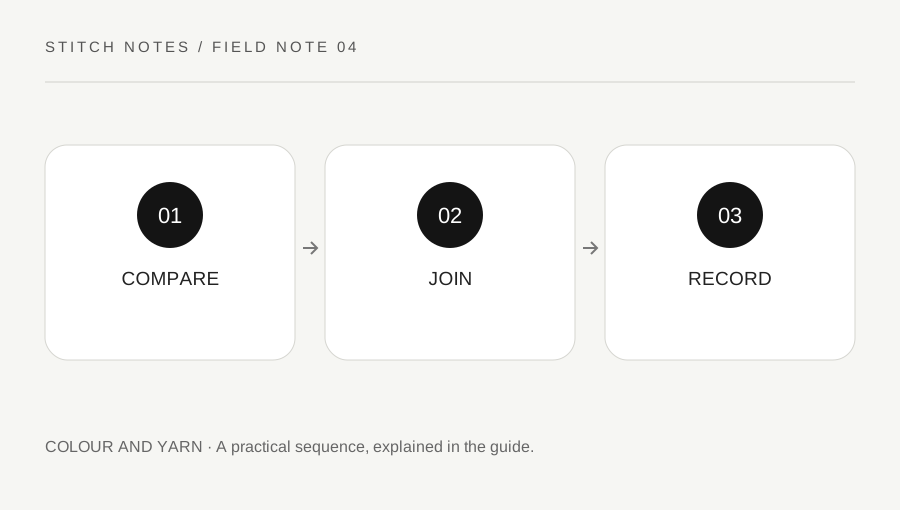
Original explanatory diagram. Examples illustrate a method or decision; they are not claims of personal testing.
Compare the actual yarn before joining
Read the yarn name, fibre information, weight description and colour details on both labels. Where dye-lot information is supplied, record it rather than assuming two matching colour names guarantee an identical appearance. Examine the strands in the same ordinary light. A label comparison is a useful check, not proof that every ball will behave identically.
Keep enough of the old yarn to make the intended join and finish. Do not wait until the remaining strand is too short to control comfortably. If the pattern asks you to join at a particular location, plan ahead for that point. A convenient interruption in the household routine is not necessarily a suitable interruption in a complicated stitch sequence.
Choose a supported method for the fabric
Use the joining method supplied by the pattern or a reliable technique suited to the actual yarn. Some projects can introduce the new strand through a stitch transition, while others require a different approach. Avoid declaring one knot or splice universally secure for every fibre, texture and use.
Leave usable ends and keep the join accessible while you inspect it. Working over a tail can help manage it in some structures, but it is not automatically the whole finishing process. Lion Brand's end-management guidance provides background on that distinction. A join that is convenient during crocheting still needs appropriate finishing and a check of its visible and tactile effect.
For a plain US single-crochet sample using a last-pull-through transition, work the old strand until two loops remain on the hook. Complete that stitch with the new supply strand, then make the next stitches with that new working yarn. Keep both tails available for a suitable finish. This illustrates one supported transition; use a different method when the actual yarn or pattern calls for it.
Protect the pattern position at the pause
Before replacing the ball, note the row or round and the point within any repeat. Place an appropriate removable marker where it helps identify the active location without damaging the yarn. Keep the current count or completed-repeat note with the project so joining the supply does not become a reason to guess where to resume.
If the work is laid aside, secure the active loop through an appropriate project-holding method rather than relying on a hook that can slide out. Keep the tail and working strand distinguishable. When returning, verify the recorded position against the actual stitches before making several new stitches that might conceal a mistaken restart.
Use a short plain-swatch comparison
Imagine a plain practice swatch that needs more of the same yarn. The maker compares labels, records the current row and introduces a new strand with a supported method. They complete a few ordinary stitches and lay the work flat. The first inspection looks for a visible colour shift, a bulky join or a point that draws the row inward.
The maker records what is observed without claiming that a short sample proves years of durability. If the new supply looks different, they pause before continuing the main piece and decide how to handle that real difference. This invented example illustrates a controlled transition. It does not promise an invisible join or prescribe one method for all fibres.
Finish and retain useful yarn information
Secure the ends according to the chosen method and the actual project, preserving the fabric's ordinary shape. Inspect both sides and handle the sample appropriately for its use. Keep the label or a clear record of the yarn in case a later care or matching question arises.
When planning another project, allow for joining and finishing rather than treating the last few centimetres of every ball as fully usable working length. Do not invent an exact allowance from this example; follow the actual pattern and yarn needs. The useful routine combines a suitable connection, an accurate restart position and an inspected finish, so a new ball becomes a clear transition rather than a hidden weak point or a lost pattern repeat.
A practical checklist
Choices are saved in this browser. Reset them here or clear this site’s browser storage.
Questions that come up
Does the same colour name guarantee a match?
No. Check the actual labels, any dye-lot information and the strands together. The name alone does not establish identical appearance.
Is one knot suitable for every yarn?
No. Use a method suited to the fibre, structure and intended use, following the actual pattern and reliable technique guidance.
What should I record before pausing?
Record the row or round, the position within a repeat and any useful count, then verify that note against the fabric when returning.
References & scope
Background references checked on 18 October 2026. Worked examples and diagrams are original teaching material.