Your First Chain and Single Crochet Swatch
A small swatch is a useful first project because every stitch is easy to find and count. Here you will make ten single crochets across six rows. You are learning how the hook, yarn, and fabric move together; speed is not the goal. The instructions assume right-handed working direction, but the stitch sequence and counts are the same for a left-handed crocheter working in the opposite direction. All names are US crochet terms.
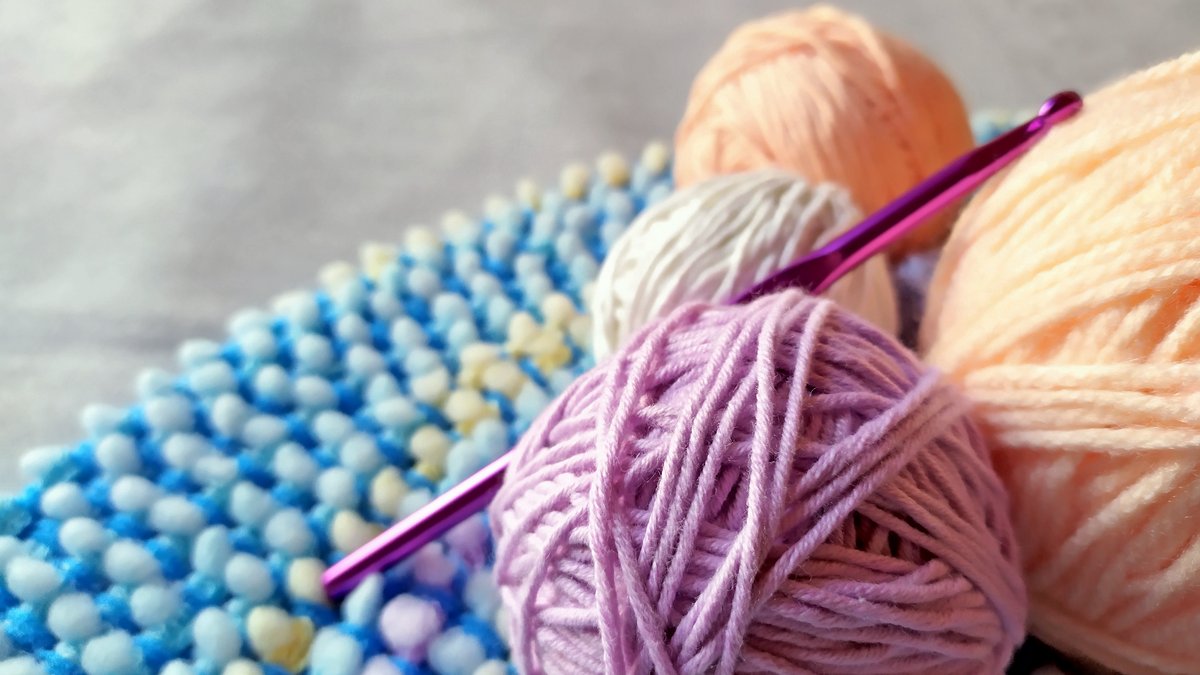
Photo: Karina Lopez · Photo license. Real crochet reference photograph; pictured yarn, tension and finished dimensions may differ from the written project.
What you need
- Smooth, light-colored medium-weight yarn
- A hook around the size recommended on the yarn label
- Two removable stitch markers, scissors, and a yarn needle
Step by step
- Make a slip knot with a tail long enough to weave in later. Place its adjustable loop on the hook and snug it gently. The loop should slide along the hook without falling off or clamping tightly around the shaft.
- Make 11 chains. For each chain, bring the working yarn over the hook and pull it through the existing loop. Count the 11 completed V-shaped links; do not count the loop still on the hook or the slip knot.
- Row 1: skip the chain nearest the hook. Insert the hook under the upper loop of the second chain from the hook, yarn over, and pull up a loop. With two loops on the hook, yarn over and pull through both. That is one sc.
- Continue one sc in each remaining chain, using the same insertion method throughout. There should be 10 sc. Mark the top of the first and last sc, leaving the skipped chain unworked.
- Rows 2 through 6: ch 1 and turn. The ch 1 does not count as a stitch. Work one sc under both top loops of each of the 10 sc across, beginning in the first real stitch. Count 10 sc at the end of each row.
- After row 6, cut the yarn with a generous tail, pull the tail through the last loop, and snug it. Thread the tail through the yarn needle and weave through several stitches on the reverse, changing direction. Trim only after the tail is secure.
Set up a comfortable working rhythm
Hold the hook in whichever grip lets your hand stay relaxed. Feed the working yarn through your other hand with enough control to form even loops, but do not wrap it tightly around a finger. Support the fabric close to the stitch you are making. Work under good light, and pause when your hands feel tired. The first few attempts may look irregular; consistent handling usually matters more than a particular grip.
Find the full stitch
Look down at the upper edge after finishing row 1. Each single crochet has two top loops forming a V. For later rows, put the hook beneath both of them. The loop already sitting on your hook belongs to the working process and is never an extra completed stitch. Move the edge markers into the newly made first and last stitches of each row. They provide a clearer boundary than the small turning chain.
Diagnose a tight foundation
If inserting the hook into the first row takes force, the foundation chain may be too tight. Restart with looser chains rather than splitting the yarn with the hook. A slightly larger hook can help make the chain, but switch back to your main hook for the stitches and note the change. Keep each chain similar in size. One very loose chain followed by several tight ones makes the foundation harder to read.
Read the result before trying another stitch
Lay the six-row swatch flat without stretching it. Ten stitches should remain across every row, and neither edge should steadily widen or taper. A curled first row alone does not prove you made an error; inspect the count and foundation tension. If the fabric narrows, check the last stitch of each row. If it widens, check whether you worked into the turning chain or made two sc in a single stitch.
Use the practice piece
Keep this swatch as a reference and label it with the hook size and yarn name. Make a second one later to compare your stitch consistency. Because there is no target finished size, you do not need to force it to match someone else's dimensions. Before moving to a coaster, practice recognizing the first and last stitches without relying entirely on the markers. That skill transfers to almost every flat beginner project.
Your quick checklist
- Foundation: 11 chains.
- Every row: 10 sc.
- Total: 6 rows, or 60 sc.
- Turning chains are excluded from stitch counts.
Common questions
Why are 11 chains used for 10 stitches?
The nearest chain is skipped to begin the first sc. The other ten chains each receive one stitch.
Can I use dark or fuzzy yarn?
You can, but smooth pale yarn makes the chain links and top loops much easier to identify while learning.
Must my swatch be a perfect rectangle immediately?
No. Aim for the correct count and recognizable edges first, then refine tension with another short swatch.