Choose Yarn, Hook Size, and Gauge for a Small Project
A yarn category and hook recommendation give you a starting point, not a guaranteed fabric size. Two people can use the same materials and produce different results because their loops are formed differently. For a coaster or bookmark, that usually means adjusting dimensions or fabric density. For a fitted garment, matching the pattern gauge is much more important. Start with a small project so that you can see these relationships without committing to a large amount of yarn.
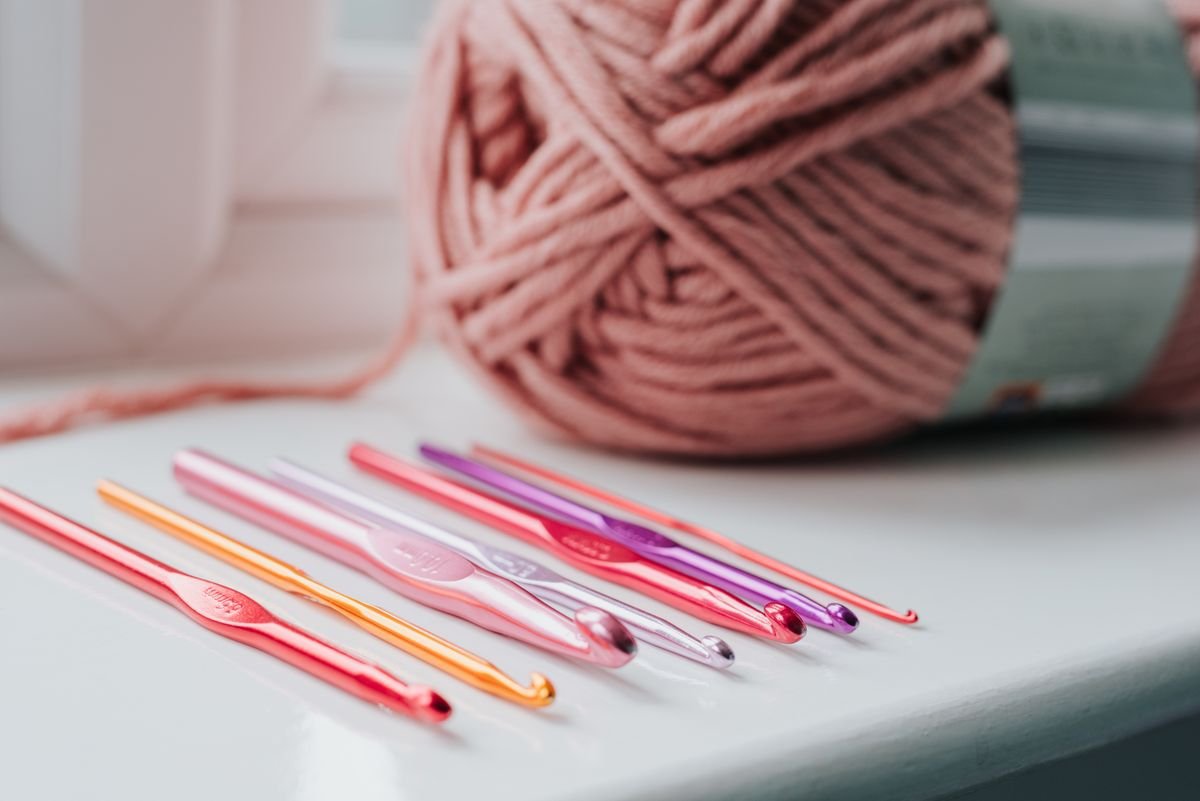
Photo: Anete Lusina · Photo license. Real crochet reference photograph; pictured yarn, tension and finished dimensions may differ from the written project.
What you need
- Yarn with its original label
- Two nearby hook sizes if available
- Ruler or tape measure, stitch markers, and a note card
Step by step
- Read the label for fiber content, yarn category, suggested hook, length, and care instructions. The ball's weight describes how much yarn you have; its yarn-weight category describes its general thickness.
- Choose an initial hook in millimeters. Letter labels can vary between manufacturers, so record the metric size as the useful comparison. Make a swatch in the same stitch and loop placement as the planned project.
- Make the swatch larger than the area you will measure. Lay it flat and count whole stitches and rows across an interior section, avoiding the edges. Measure without stretching the fabric.
- If the project will be washed, care for the swatch according to the yarn label, let it dry, and measure again. Record both measurements rather than assuming the unwashed fabric is the final size.
- Compare the fabric and the numbers. A larger hook usually makes larger stitches and fewer stitches per inch; a smaller hook usually does the opposite. Change one variable at a time, then make and measure a fresh sample.
Choose a readable first yarn
A smooth, light, solid color makes it easier to see each stitch. Very fuzzy yarn can hide the top loops; loosely spun or easily split yarn can make inserting the hook harder. Cotton can be a useful choice for a small drink coaster because it creates a relatively firm fabric, but the fiber label and care instructions still matter. Choose a yarn you can identify and obtain again if you want to make a matching set.
Think about the finished object
A bookmark should be thin enough to sit between pages without creating a bulky ridge. A coaster needs to lie flat and be large enough for its intended cup or glass. Neither project needs the same drape as a scarf. Evaluate your swatch by handling it, not only by checking a hook chart. A fabric full of large holes may be attractive but less suitable for the object you planned.
Calculate a dimension estimate
If your swatch has 4 sc per inch, a width of 16 sc is approximately 4 inches. If it has 4.5 rows per inch, 16 rows are approximately 3.6 inches. The same stitch and row count therefore does not guarantee a square. Use the actual measured gauge and divide the planned count by that gauge. Keep units consistent, and round the estimate sensibly rather than giving a false impression of precision.
Adjust with a clear record
For a plain rectangle, you can change the number of stitches, rows, or hook size. Write the modification beside the original instructions so you can reproduce it. If you change a foundation from 17 chains to 21 chains in our simple sc construction, row 1 becomes 20 sc, not 21. If you change the stitch pattern, calculate any repeat multiple before altering the chain. A textured or shaped project may not allow a simple one-for-one substitution.
Allow enough yarn for finishing
Small pieces still need tails for weaving in, and a swatch uses part of your supply. When substituting yarn, compare usable length as well as ball weight. A heavier ball is not automatically longer. Exact yardage varies with stitch size and finishing, so avoid planning a project around the final few inches of a scrap. Keep the label with the remaining yarn and note dye information when a matching color is important.
Use category charts as a reference
The Craft Yarn Council yarn-weight system groups common yarn thicknesses and presents hook and gauge ranges as guidelines. We link to that original chart instead of reproducing it. Your chosen pattern and measured swatch are the practical decision tools. The Council is an independent background source and does not endorse these projects. No sample gauge printed here is a claim that every yarn in a category will produce that result.
Your quick checklist
- Record fiber, hook millimeters, and yarn length.
- Measure interior stitches without stretching.
- Use the same stitch as the actual project.
- Recheck dimensions after appropriate care.
Common questions
Do I need an exact gauge for a coaster?
Not necessarily, but you should measure its actual width and check that the fabric is stable and flat.
Can I substitute any yarn labeled medium?
Treat it as a starting point. Fiber, construction, thickness, and your own tension can still change the result.
Should I steam-block every piece?
No. Follow the fiber care guidance. Heat can damage some yarns; do not assume that steam is appropriate.