A Ribbed Crochet Bookmark Worked in Back Loops
Back-loop-only single crochet creates visible ridges without requiring a new stitch motion. This bookmark keeps the construction simple: eight stitches across, 32 rows long, and no tassel or beads. Use a smooth, fairly fine yarn so the finished strip is comfortable between book pages. All instructions use US terms. The counts have been checked editorially, but this is not a claim of physical sample testing or an exact finished size.
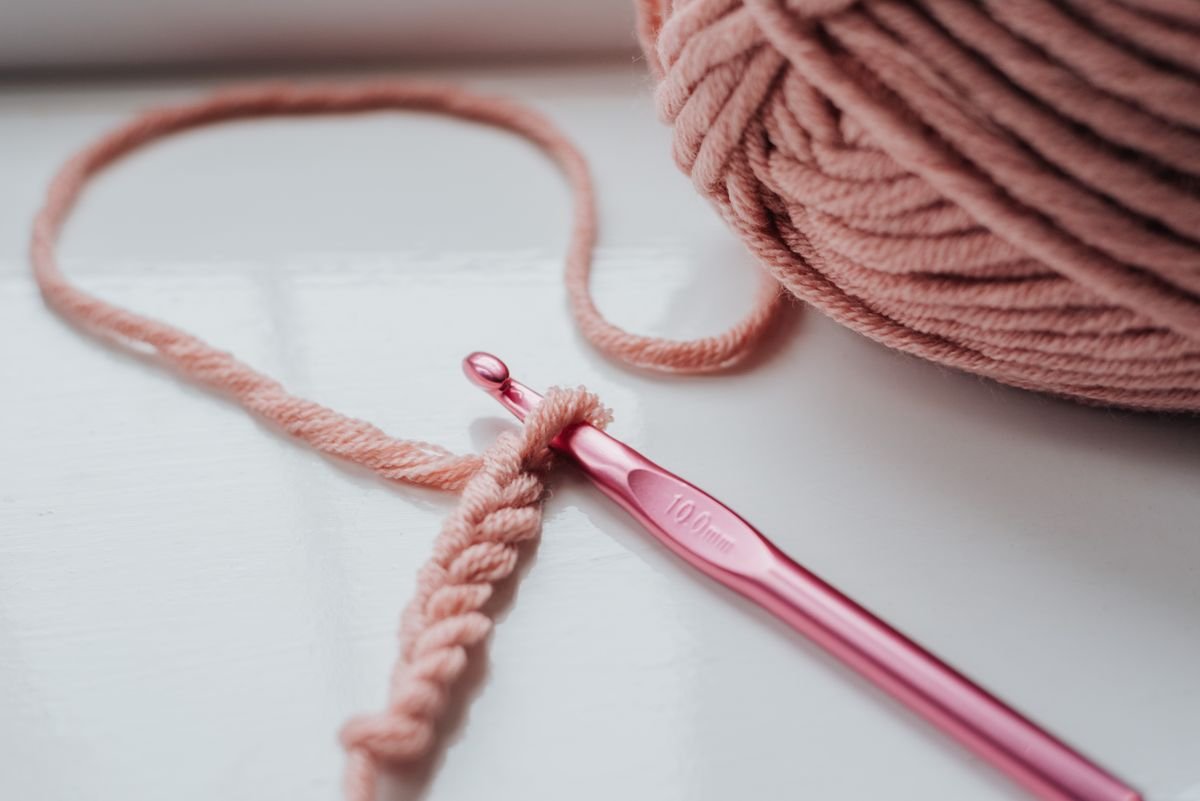
Photo: Anete Lusina · Photo license. Real crochet reference photograph; pictured yarn, tension and finished dimensions may differ from the written project.
What you need
- Smooth fine cotton yarn or another thin yarn suitable for a bookmark
- A matching hook chosen for a neat, flexible fabric
- Two removable markers, scissors, yarn needle, and ruler
Step by step
- Foundation: ch 9 with even tension. Leave a tail long enough to weave in securely. Count the nine completed chain links without counting the working loop on the hook.
- Row 1: sc in the second ch from the hook and each remaining ch across, using a consistent insertion method. You now have 8 sc. Mark the top of the first and last sc.
- Row 2: ch 1 and turn. Find the two top loops of the first sc. Work one sc through the back loop only, which is the loop farthest from you as the turned row faces you. Continue one BLO sc in every stitch across. Count 8 sc.
- Rows 3 through 32: repeat row 2, turning before each new row and identifying the back loop from your current viewpoint. Move both markers into the new first and last stitches. Keep 8 sc per row; the ch-1 turning chain is not a stitch.
- Length check: lay the bookmark flat after row 32 and compare it with the intended book. This is the base stopping point. If you need a different length, add or remove complete rows while keeping 8 sc across, and record your final row count.
- Finish: pull a generous cut tail through the final loop. Weave both tails along the reverse of the stitches, changing direction without cinching the strip. Follow the yarn label for any washing, then dry flat and check the final dimensions.
Understand the loop choice
The front and back loops are the two strands of the V at the top of a stitch. Back loop does not mean an extra strand on the reverse side of the fabric. After turning, the orientation of the fabric changes, so identify the farther of the two loops again. The unworked front loops help form the surface ridges. Row 1 is a regular sc foundation row; all 31 later rows use BLO sc.
Count rows independently of ridges
The base bookmark contains 32 rows of 8 sc, for 256 sc overall. Row 1 contributes 8 ordinary sc; rows 2 through 32 contribute 248 BLO sc. The raised texture can make pairs of rows look like a single visual band, so do not rely on counting bands alone. Tick each completed row on paper. If you set the project down, leave a marker in the working loop and keep your progress note with it.
Choose a useful thickness
A bulky strip may look attractive but can hold a book open awkwardly. Make a few rows, place the sample between pages, and check how it feels before continuing. A finer yarn generally produces a thinner piece, but hook choice and your own stitch tension also matter. Avoid making the fabric so tight that you must force the hook into a loop. The bookmark should remain flexible rather than stiff like a cord.
Adjust dimensions deliberately
The width is eight stitches divided by your stitches per inch; length is 32 rows divided by your rows per inch. For example, a hypothetical gauge of 6 sc and 8 rows per inch would produce roughly 1.3 by 4 inches. Your fabric may differ substantially. To widen this plain strip, start with one more chain than the desired stitch count. To lengthen it, add full eight-stitch rows; do not add extra chains at the end.
Fix texture and edge mistakes
An occasional stitch worked under both loops creates a local change in texture, even if the count remains correct. If you want a consistent rib, undo to that stitch and remake it in the back loop. A steadily narrower strip usually points to a missed edge stitch. A steadily wider strip often means the turning chain was included. Correct the source of the error rather than adding a compensating stitch several rows later.
Keep the finish simple
This base pattern omits tassels, beads, and glued embellishments. Neatly woven tails make a flatter bookmark and avoid hard parts pressing against the pages. Check that no cut tail is loose enough to pull out during normal handling. Use the same care method every time you make a matching bookmark; washing or shaping can change its length and the way the ridges relax.
Your quick checklist
- Foundation: ch 9.
- Every row: 8 sc.
- Rows 2–32: BLO throughout.
- Base total: 32 rows and 256 sc.
Common questions
Should the first and last stitch also use BLO?
Yes, in rows 2 through 32 this base version uses BLO for all eight stitches.
Why does my bookmark stretch?
The ribbed structure and yarn can stretch. Measure it relaxed, and avoid pulling it longer to meet a target number.
Can I stop before row 32?
Yes. Keep complete rows and record your new total; the base count applies only to the 32-row version.