Before Blocking Crochet: Match the Method to the Yarn and Pattern
Blocking is a finishing decision governed by the actual yarn and project. Start with the care information and a spare sample rather than applying the same water or heat treatment to every fibre. This guide focuses on preparation and honest measurement.
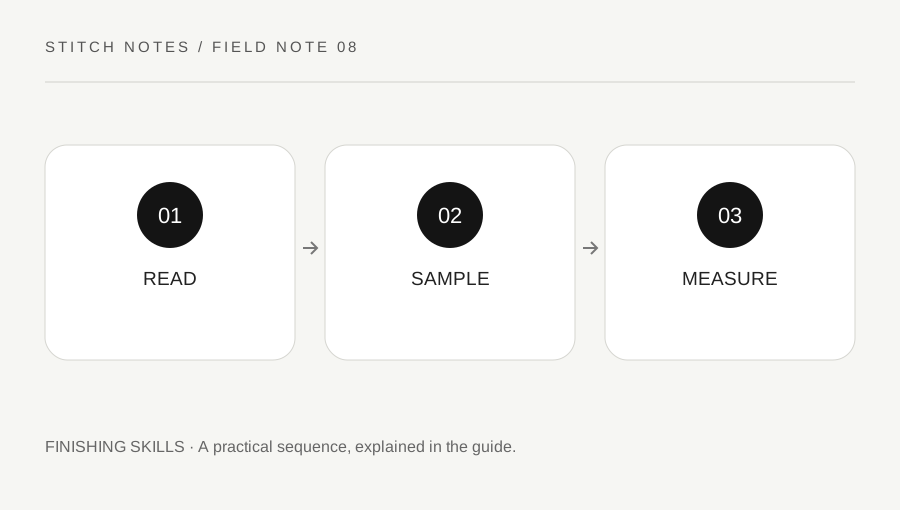
Original explanatory diagram. Examples illustrate a method or decision; they are not claims of personal testing.
Read both yarn and project instructions
Keep the yarn label and the actual pattern's finishing guidance together. Identify the fibre content and the permitted care methods before choosing a treatment. An instruction for a different yarn or garment is not automatically transferable. If the information is unclear, ask the responsible manufacturer or designer through its official route.
Do not use heat merely because a tutorial shows steam on another material. Some treatments can change the fabric in ways that cannot be undone. This article does not prescribe a universal temperature, soaking time or stretching target. Its practical role is to help you identify the governing instructions and the questions a suitable spare sample should answer.
Choose a representative spare sample
Use a sample made from the actual yarn and stitch structure where possible. A different yarn may behave differently even when its colour and thickness appear similar. Record the hook, stitch structure and condition of the sample so a later comparison has context. Keep it separate from the main project while testing the approved treatment.
Inspect its baseline shape and measurements without forcing it flat or stretching it to a preferred number. Choose consistent reference points and write them down. The goal is to compare the same feature before and after an appropriate treatment, not to obtain a more pleasing measurement by changing where the ruler starts.
Measure a change without inventing a target
Suppose an illustrative sample measures ten centimetres between chosen points before an approved treatment and ten and a half centimetres afterward in the comparable finished condition. The observed increase is half a centimetre, or five percent of the original ten. That arithmetic describes the hypothetical observations; it is not an instruction to stretch a real sample by five percent.
Measure width and height separately where relevant. A fabric can change differently in the two directions, so one number should not be used as a universal scaling factor. Record the actual condition in which you measured, such as fully dry according to the method's instructions. Do not compare a damp stretched sample with an unstressed dry sample and call the difference a reliable finished-size result.
Plan the surface and tools appropriately
Use a suitable surface and tools for the approved method, following their instructions. Protect household surfaces appropriately and keep any pins or small tools controlled and accounted for. Do not assume furniture upholstery, an ordinary metal pin or a nearby heat source is suitable simply because it is available.
Preserve the actual project's intended dimensions and construction. Blocking is not a substitute for missing stitches, an incorrect repeat or a misunderstood seam. If a sample reveals a significant mismatch, review the underlying yarn, gauge and construction with the actual pattern information. Avoid promising that finishing will correct every fabric problem discovered at the end.
Keep a useful finishing record
Write the approved method, actual sample observations and any unresolved question. Distinguish what you performed from what you only plan to try. Lion Brand's project-specific blocking discussions show why finishing belongs with a particular construction; the original sample worksheet here is a general preparation method, not a reproduction of those garment instructions.
Return to the main project's directions before proceeding and keep the care label with the finished item where useful. For a gift, provide the recipient with relevant care information rather than assuming they know the yarn. A good finishing decision begins with the material, uses an appropriate sample and records actual results without turning a hypothetical example into a tested treatment.
A practical checklist
Choices are saved in this browser. Reset them here or clear this site’s browser storage.
Questions that come up
Should every fibre be steam blocked?
No. Use the actual yarn and project guidance. Heat can cause changes that are unsuitable or irreversible for some materials.
Does blocking fix an incorrect stitch count?
It does not replace the missing or extra stitches. Review the construction problem rather than relying on finishing to conceal it.
Is the five-percent example a target?
No. It is arithmetic using hypothetical measurements, not a recommended amount of stretch or a reported test result.
References & scope
Background references checked on 18 October 2026. Worked examples and diagrams are original teaching material.